> For the complete documentation index, see [llms.txt](https://whitepaper.anttime.net/llms.txt). Markdown versions of documentation pages are available by appending `.md` to page URLs; this page is available as [Markdown](https://whitepaper.anttime.net/tokenomics/time-coin.md).
# TIME Coin
Used across all ANTTIME ecosystem.
## 1. Overview
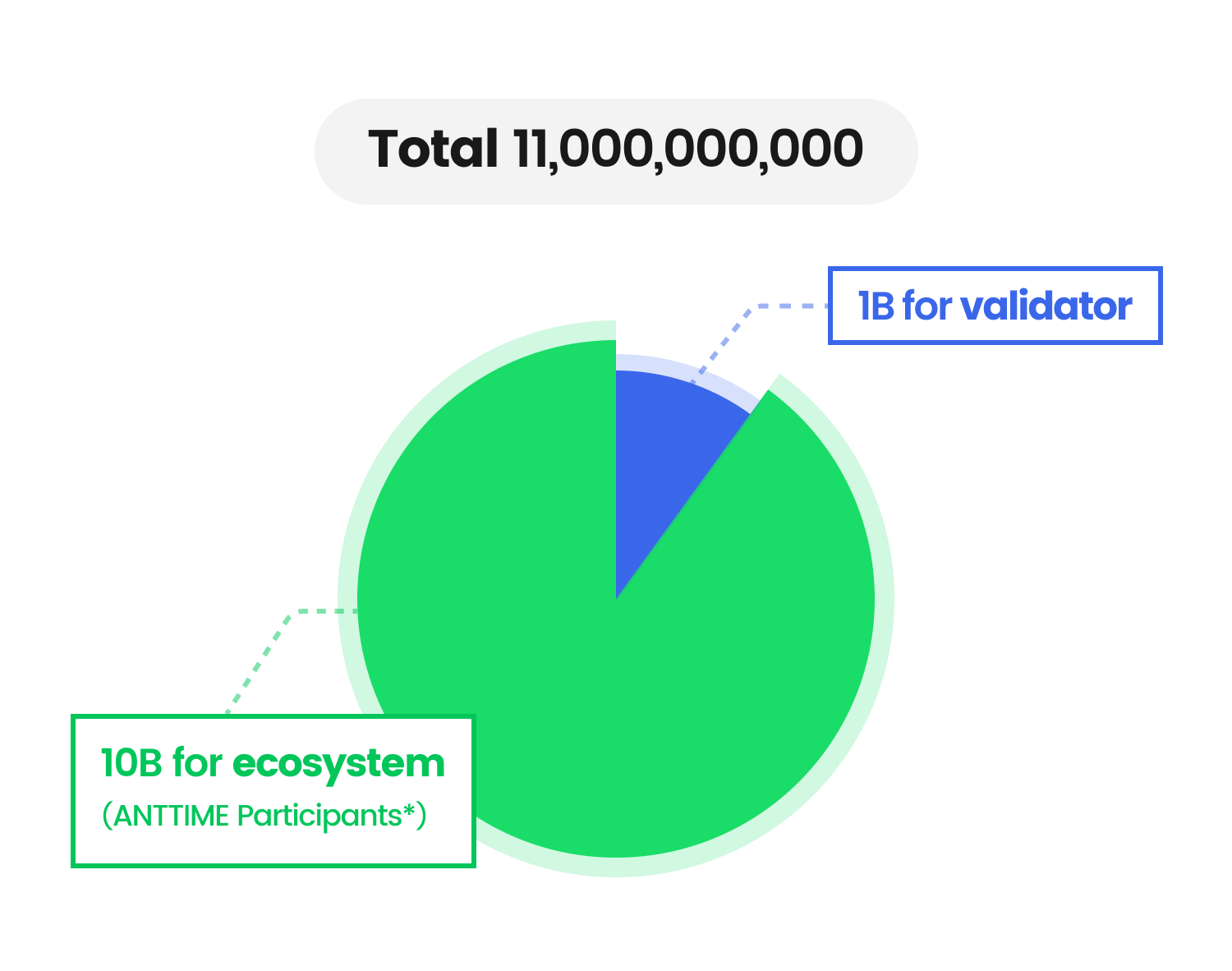
All users can produce TIME using time as an absolute value. With this time-based asset, they can participate in the TIME Blockchain ecosystem and engage in various economic activities such as creation, ownership, and revenue generation within the metaverse. TIME Coin starts with an initial supply of 11 billion TIME coins and generates a new block every 1 seconds after the genesis block. Out of the initial supply of 11 billion TIME coins, 10 billion TIME coins are dedicated to the ANTTIME ecosystem, and the remaining 1 billion TIME coins are allocated for governance distribution.
✅ **Ecosystem: 10,000,000,000 TIME** (distributed to ANTTIME Participants\*)
✅ **Validator: 1,000,000,000 TIME** (distributed to TIME Provers over 10 years)
\* "Participants" means all those who contribute to the ANTTIME & TIME Ecosystem, including ANTTIME users, Liquidity Providers, Community, Developers, Foundation, Early Adopters and Supporters.
## 2. Structure
The TIME Coin produced through participation in ANTTIME has a structure that encompasses both the real world and the metaverse in the Web3 era.
✅ **Enhancing TIME production efficiency.**
✅ **Economic activities such as creation, ownership, and revenue generation within ANTTAVERSE.**
✅ **Rewards for TIME Provers.**
✅ **Transaction fees within the TIME Blockchain.**
.png)